BIC Facility Codes
Search the container facility database
BIC Codes
Search container owner codes

Container line HMM (Hyundai Merchant Marine) is the latest global carrier to join the BoxTech Global Container Database, making details of more than 11 million units in total available to registered users.
HMM, the 12th largest global carrier, joins 2M carriers Maersk and MSC (Mediterranean Shipping Company), which have already uploaded their container fleets to the database, operated on a non-profit basis by the BIC (Bureau International des Containers). Other major carriers, including CMA-CGM and APL, have also registered their fleets, alongside hundreds of smaller owners and operators.
With the addition of HMM, Korea is now particularly well represented within the BoxTech Global Container Database, with SM Line, Pan Ocean and CK Line having previously uploaded their fleets.
With details of more than 11 million containers, the fast-growing database gives the shipping community instant access to the technical characteristics of around 45% of the global container fleet in a single location, using a standard API.
To sign up to the BoxTech Global Container Database, or for more information, visit www.bic-boxtech.org.
Download our press release here
BIC Facility Codes
Search the container facility database
BIC Codes
Search container owner codes
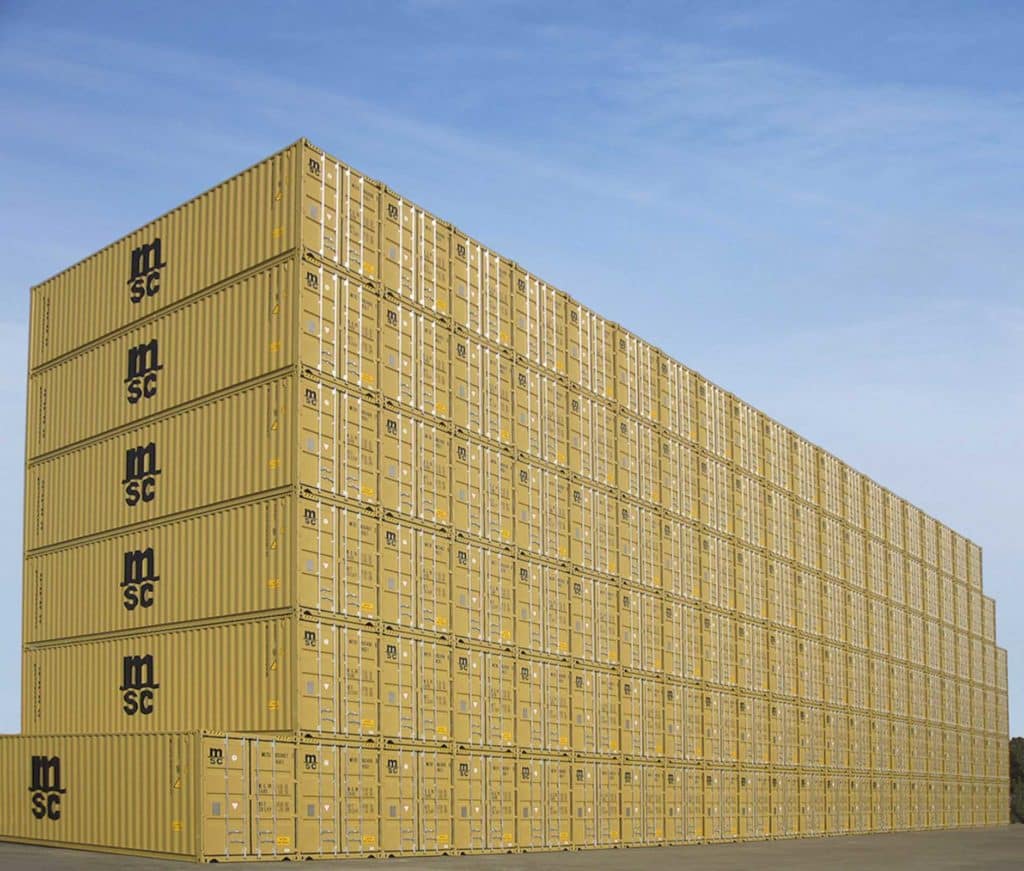
The MSC fleet upload occurs as BoxTech, the non-profit global container database operated by the Bureau International des Containers (BIC) approaches its two-year anniversary. MSC joins other leading global carriers, such as CMA-CGM and Maersk Line, in adopting the BoxTech solution in their businesses. Hundreds of other container owners and operators are also utilizing the platform, including two of the top four container leasing companies.
“Transparency and easy, standardized data access are vital to many of the digitalization efforts underway in the shipping industry,” says André Simha, Chief Information Officer, MSC Mediterranean Shipping Company. “MSC therefore fully supports the BoxTech Global Container Database and we are delighted to upload our global fleet details to help expand this neutral, non-profit platform. It has tremendous potential to help drive efficiencies in many areas.”
Douglas Owen, Secretary General of the BIC says “We are thrilled that the world’s three largest ocean carriers have now registered their fleets, thereby helping to make BoxTech a core business platform for shippers, carriers, depots and other parties to use in their day to day operations.”
Launched in July 2016, there are now more than 1500 BoxTech users who rely on the central data repository to efficiently obtain technical container details, such as tare weight, size and type, as well as utilizing more recently added functions such as verifying ownership status and posting recovery alerts. Maersk Line and CMA-CGM were among the early adopters of these helpful features and have been registering their container sales on the platform since late 2017. The new features have also proved particularly helpful among users from container leasing companies, making the recovery of units following bankruptcy easier than ever.
The BoxTech user base has also grown thanks to the many APIs available for database queries, which enable companies to digitalize more of their operations and automatically integrate container details into their everyday systems. Automated API database queries also streamline processes by avoiding unnecessary searches and increasing accuracy by removing the inevitable errors cause by manual data re-keying.
“The industry has changed in recent years as carriers look increasingly to technology and the use of data to drive efficiencies,” says Owen. “Although sharing data is something that has come slowly in our industry, we have seen unprecedented cooperation over the past two years and a new openness to the use of common platforms.”
“Organizations across the world are telling us that they want an open, impartial solution, and there is growing demand for more data from more container shipping companies to be added to the database,” explains Owen. “Our industry is keen to adopt this new digital and collaborative way of working, and we encourage the remaining carriers and container lessors to register their fleets on the platform now.”
To sign up to the BoxTech Global Container Database, or for more information, visit www.bic-boxtech.org.
The BIC operates the neutral, non-profit BoxTech on a non-commercial basis to support visibility, transparency, efficiency and security. It is one of many registration databases that the BIC operates to support the international container industry. For more information about the BIC, visit www.bic-code.org.
“Transparency and easy, standardized data access are vital to many of the digitalization efforts underway in the shipping industry,” says André Simha, Chief Information Officer, MSC Mediterranean Shipping Company. “MSC therefore fully supports the BoxTech Global Container Database and we are delighted to upload our global fleet details to help expand this neutral, non-profit platform. It has tremendous potential to help drive efficiencies in many areas.”
BIC Facility Codes
Search the container facility database
BIC Codes
Search container owner codes
Please contact us at [email protected] to submit nominations for the 2018 BIC Award
BIC Facility Codes
Search the container facility database
BIC Codes
Search container owner codes
Find out more about the program below
BIC Facility Codes
Search the container facility database
BIC Codes
Search container owner codes
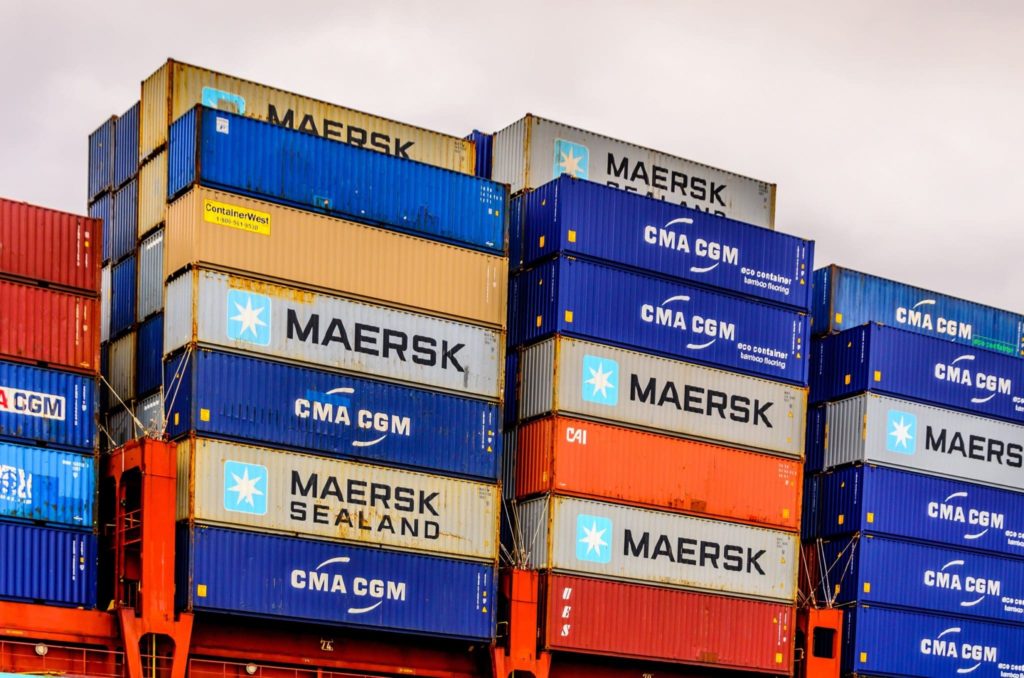
New BoxTech Container Database Upgraded
Innovative functions immediately utilized by Maersk Line and CMA-CGM
BoxTech, the database of technical details for containers, has introduced a number of new functions which will help shippers save time, and enable equipment owners to register container sales and flag units with exception alerts. Two of top three global carriers are already using the new features.
The fast-growing database, which is provided by the Bureau International des Containers (BIC) and already includes the technical characteristics of more than 30 per cent of the global container fleet, is continually evolving to meet the needs of the shipping industry.
Containers Sold
One new function allows owners to indicate in the BoxTech database when containers have been sold. This will alert anybody, or any system, searching for a container which has been sold that it is no longer part of that company’s fleet. This will help prevent improperly-marked containers from circulating with the markings of their previous owner, improving safety, reducing risk and helping to encourage the proper neutralization of sold containers.
This functionality is already being used by leading ocean carriers CMA-CGM and Maersk Line, both of which have uploaded their entire global container fleets to the database and are now flagging units whenever they are sold.
“CMA-CGM was an early adopter of BoxTech and Maersk one of our more recent, but both clearly understand the value of a central, non-profit information source and both have provided leadership to the industry,” explains Douglas Owen, Secretary General of the BIC. “Both have provided input that has been instrumental in developing new ideas and updates for BoxTech, in particular the new container sales function.”
“Maersk is on a journey to integrate and simplify global supply chains, so we are in full support of the neutral BoxTech database as a tool to help improve transparency and efficiency in the industry,” says Ingrid Uppelschoten Snelderwaard, Head of Equipment at Maersk. “The new container sale function offers additional clarity, showing a clear dividing line between our current fleet and containers that have been sold. We appreciate that the team at BIC continues to innovate to bring new tools to benefit the industry”.
Recovery Alerts
Another new feature, the new BoxTech Recovery Alerts system enables container owners to create alert lists to flag specific units in case of bankruptcies and other recovery situations, such as lost or stolen units. It can also inform users whenever a special status exists for a given unit.
“CMA-CGM was one of the earliest supporters of BoxTech, so we are happy to see how it has grown over the past year,” says Philippe Berard, Equipment & Depot Senior Manager, from CMA-CGM. “We are especially pleased with the new container sale flags function, as this allows us to clearly indicate when containers have been sold and are no longer our responsibility. We also appreciate the exception alert flags, which will help provide much-needed visibility and information to trading partners in case of special situations”.
This new feature is also of particular use to container leasing companies needing to recover units, as well as the shippers, terminals, ports, and rail and motor carriers within the 1100 strong BoxTech user base.
New APIs
To help container owners keep BoxTech updated seamlessly, new APIs are available to automate the process. This removes the requirement for a manual task, and allows companies to save time, reduce human error and keep the database up to date more easily. The more container information available in the database, the more helpful the system is to users.
APIs can also be put in place for conducting an increased number of database query types, enabling shippers, and other parties, to automatically conduct searches tare weight, size and type, maximum gross mass, or other container characteristics – returning the information directly into their systems where they need it. This provides BoxTech users with easier access to a greater amount of information.
“The new functionality has been introduced in response to industry feedback, giving users more seamless, secure and digitally integrated processes supported by BoxTech,” says Douglas Owen. “Many of the largest carriers and leasing companies are already signed up to BoxTech, and we hope to continue to see more organizations following suit – for their own efficiency and safety gains, but also for the benefit of the industry as a whole,” he concludes.
To sign up to the BoxTech Technical Characteristics Database, or for more information, visit www.bic-boxtech.org.
For more information about the BIC, visit www.bic-code.org.
BIC Facility Codes
Search the container facility database
BIC Codes
Search container owner codes
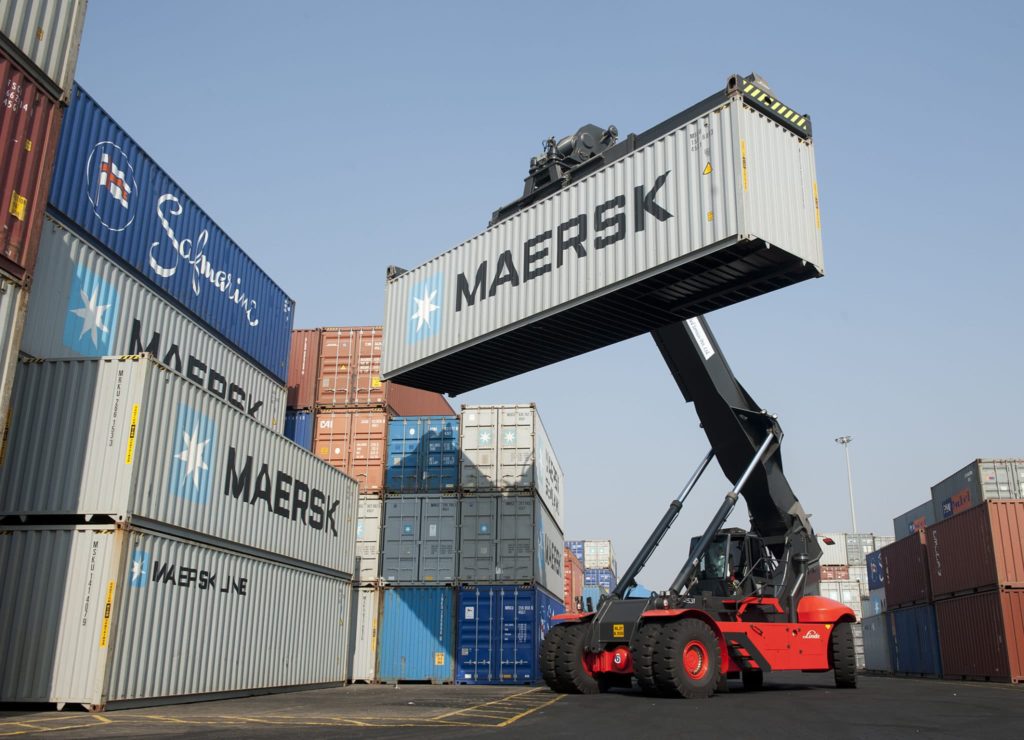
Global container shipping company Maersk Line has uploaded the technical details of its entire container fleet to BoxTech, the fast-growing database provided by the Bureau International des Containers (BIC). Following the upload, the BoxTech database now holds details of more than 7.5 million shipping containers, approximately 30% of the global container fleet.
Launched in July 2016, the non-profit BoxTech Technical Characteristics Database has helped hundreds of shippers, forwarders, terminals, and other parties to digitalize more of their operations. With more than 1000 total users, the database is utilized to obtain container weights and sizes and will soon offer additional functionality such as status and recovery alerts.
The easily integrated and automated system enables a seamless flow of container information between different parties throughout the supply chain, increasing efficiency and reducing manual tasks. Maersk Line is one of the latest companies to benefit, following the upload of their entire worldwide container fleet.
“We strive to simplify and create transparency across our customers’ entire supply chains. This digital platform provides our customers ease in complying with industry regulation. In turn, access to precise data on the weight of the loaded container will support our drive towards increased fleet safety,” says Ingrid Uppelschoten-Snelderwaard, Head of Equipment at Maersk Line.
Douglas Owen, Secretary General of the BIC commented “We’re delighted that Maersk Line has uploaded their fleet in support of BoxTech and we are confident that their customers and trading partners will be equally pleased. The enhanced visibility and automated data access improves safety and security, and also means efficiency gains and cost savings right through the supply chain.”
Signing up to BoxTech is quick and simple and the initial file of container fleet technical details is uploaded easily using a CSV template. Subsequent data uploads can then be automated via APIs, saving time and increasing digitalization. APIs can also be put in place for conducting database queries, allowing seamless integration of necessary container details directly into systems. The database is continually developing and evolving to best meet the data needs of the shipping industry.
“With 2 of the top 3 global carriers, and 2 of the top 4 leasing companies now having loaded their fleets in BoxTech, shippers are beginning to experience just how beneficial such a database can be,” adds Douglas Owen. “More fleets are being added all the time, and the closer we get to the entire global fleet, the more the industry benefits from BoxTech”.
To sign up to the BoxTech Technical Characteristics Database, or for more information, visit www.bic-boxtech.org.
The BIC will also be discussing the latest BoxTech developments at the meeting of the International Maritime Organization Sub-Committee on Carriage of Cargoes and Containers (IMO CCC) from 11th – 15th September, and with visitors at the JOC Container Trade Europe conference from 18th – 20th September in Hamburg, Germany.
The BIC supports the international container industry with multiple registration databases and operates the BoxTech Technical Characteristics Database for the industry on a non-profit basis. For more information about the BIC, visit www.bic-code.org.
BIC Facility Codes
Search the container facility database
BIC Codes
Search container owner codes

Cargo Incident Notification System receives BIC Award
The Bureau International des Containers (BIC) is pleased to announce that the Cargo Incident Notification System (CINS) has won the 2017 BIC Award. Presented annually, the award honors an individual or organization for notable contributions to safety, security, standardization, or sustainability in containerized transportation.
The BIC Award was presented to Ken Rohlmann of Hapag Lloyd, CINS Vice Chairman, and Jean-Christophe Triat of the Mediterranean Shipping Company (MSC), two of the founding members of CINS, in recognition of the work that CINS is doing to share information and improve safety aboard vessels and throughout the supply chain.
The presentation of the 2017 BIC Award was made during the annual meeting of the sub-committee on Carriage of Cargoes and Containers (CCC) at the International Maritime Organization (IMO) headquarters in London. It was presented by Douglas Owen, BIC Secretary General, and Giordano Bruno Guerrini, Chairman of the Board for the BIC.
“As a non-profit organization dedicated to safety within the shipping and container industry, BIC welcomes and encourages industry-led initiatives such as CINS,” says Douglas Owen, BIC Secretary General. “We have been particularly impressed with how CINS has brought the industry together to help improve safety throughout the supply chain. We are delighted to recognize this great achievement with a BIC Award.”
CINS was established in 2011 by five of the world’s biggest container lines; CMA-CGM, Evergreen, Hapag-Lloyd, Maersk Line and MSC, with the objective to highlight risks posed by certain cargoes and packing failures. By collecting this data within the CINS online database, trends and incidents requiring immediate action can be more easily identified than ever before.
Chairman of CINS Uffe Ernst-Frederiksen from Maersk Line says “The key driver for CINS remains ensuring safety of seafarers and all involved in the Maritime Supply Chain across the globe, as well as protecting the environment and assets. In today’s cargo booking environment it remains key to maintain a level of vigilance where certain cargoes with potential self-reactive properties are involved.”
CINS Vice Chairman Ken Rohlmann expands “CINS is a unique group of international experts, acting independently from any commercial interests, purely driven by the aim to enhance the overall safety for our colleagues, both on board our vessels and within the entire transport chain.”
Through analyzing trends and database information, CINS is helping to ensure that safety is improved. For example, once areas of concern are identified, they can be addressed to relevant authorities to formulate appropriate recommendations or advice. This can include suggesting amendments to the International Maritime Dangerous Goods (IMDG) code, or offering advice on training around the correct packing and securing of cargo.
“CINS’ strategic efforts include producing guidelines, such as for the transport of Calcium Hypochlorite, steel coils and for the use of non-operating reefers,” says Mr. Ernst-Frederiksen. “Currently, CINS expert work groups are developing best practice guidelines on further specific cargoes in containers, including the carriage of charcoal, lithium batteries, metal scrap, hides and skins, cocoa butter and radioactive cargo.”
By collating information around all incidents resulting in injury or loss of life, loss or damage of assets, or environmental concerns, CINS also supports the industry by ensuring that shipping lines have facts to rely upon in the event of regulatory intervention.
There are now 14 shipping line members of CINS representing two-thirds of the world’s containerized capacity, all of whom are able to access the information within the CINS database. There are also a number of Advisory and Honorary Members. It is led by a board of five experienced industry professionals from the founding container lines.
“This BIC Award is greatly appreciated by the CINS team and it will certainly act as an incentive to continue the committed work by CINS member companies,” concludes Mr. Ernst-Frederiksen.
For more details about CINS, visit www.cinsnet.com.
For more information about the BIC, visit www.bic-code.org.
BIC Facility Codes
Search the container facility database
BIC Codes
Search container owner codes
20,000+ TEU ships set new size records!
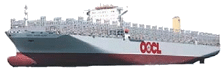
At 21,413 TEU, the OOCL HONG KONG built by Samsung Heavy Industries steals the crown for the largest container ship ever built.
The previous record holder, Daewoo’s (DSME) 20,568 TEU MADRID MAERSK, delivered in April, effectively outranked Samsung’s 20,170 TEU MOL TRIUMPH. A total of 54 ships in the 18,300-21,400 TEU range have been delivered so far, and a further 51 units are due over the next two years, based on Alphaliner records. The cumulated capacity of the 54 units represents 5% of the total cellular capacity currently in service. By comparison, the 51 remaining units represent 35% of the orderbook.
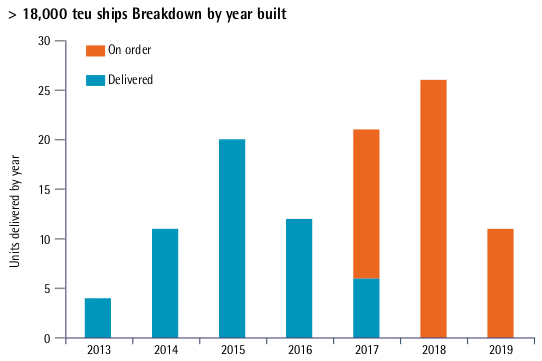
Increased capacities
Despite their capacity differences, all these ships share similar dimensions: lengths range between 395 and 400m, fitting 24 bays of 40 containers. With breadths of between 58.60 and 59.00m, 23 rows of containers can be stowed on deck with 21 rows in holds. However, each series can stow either 11 or 12 standard containers under deck (depending on hull depth) and has different bay distributions due to the different placement of the deckhouse, engine room and funnel. It appears that the 400x60m dimensions currently represent an upper size limit for ship handling under real-life conditions – even in many mainline deep water ports.
Although there is not a single factor that limits shipbuilders and carriers to opt for even larger vessels, a further step up in container-ship sizes would probably require further shore-side investments, which would have to be recouped by supply-chain savings. Instead of building physically larger (longer and wider) vessels, designers have optimized 400x59m ships for higher intakes.
World’s Largest Containerships
| Nominal TEU tdw |
LOA m |
Breath m |
Depth m |
Draft m |
||
|---|---|---|---|---|---|---|
|
OOCL HONG KONG |
|
21,413 teu
|
399.9
|
58.8
|
32.5
|
16.0
|
| MADRID MAERSK 11 units in series from Apr 2017 |
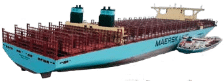
|
20,568 teu |
399.0 | 58.6 | 33.2 | 16.5 |
| MOL TRIUMPH 6 units in series from Mar 2017 |
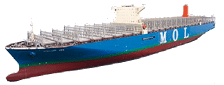
|
20,170 teu |
400.0 | 58.8 | 32.8 | 16.0 |
| BARZAN 6 units in series from Apr 2015 |
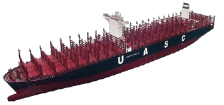
|
19,870 teu |
400.0 | 58.6 | 30.6 | 16.0 |
| MSC OSCAR 12 units in series from Jan 2015 |
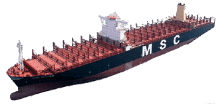
|
18,982 teu |
395.4 | 59.0 | 30.3 | 16.0 |
| CSCL GLOBE 5 units in series from Nov 2014 |
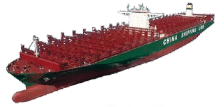
|
18,982 teu |
399.7 | 58.6 | 30.5 | 16.0 |
| Maersk ‘EEE’ 20 units in series from Jun 2013 |
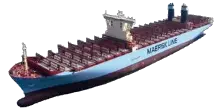
|
18,340 teu |
399.2 | 59.0 | 30.3 | 16.0 |
New alliances set-up triggers largest reshuffling ever in container shipping
The date 1 April 2017 will be remembered as the day when container shipping witnessed its biggest services-and-fleet reshuffle. Some 700 ships ranging between 4,000 to 21,000 TEU were involved in major services swaps. The reshuffling, triggered by an alliance shake-up, spans several weeks until all these ships fall into place in the service jigsaw. Networks that operated under the four ‘old’ carrier alliances (2M, G6, CKYE, O3) are to be phased out and replaced by revised services under three new alliances (2M+HMM, OCEAN Alliance, THE Alliance).
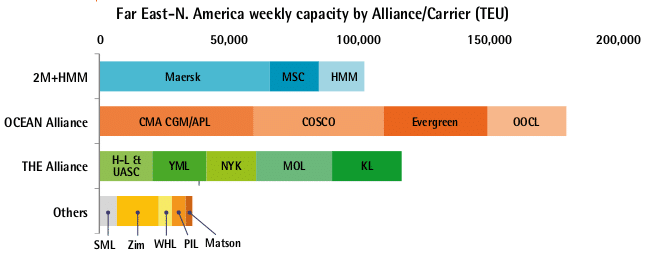
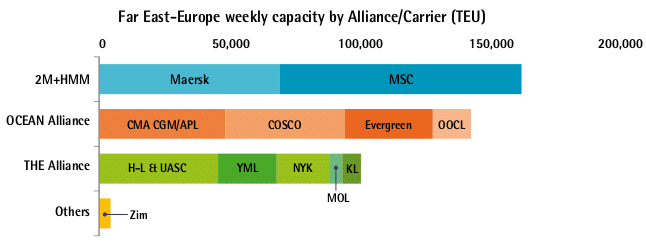
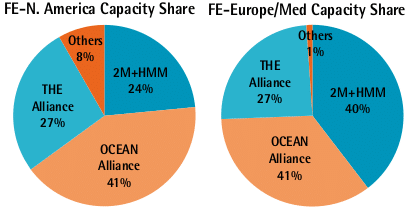
The transition also brings capacity increases across the board with carriers gearing up for the summer peak season, as well as another market-share battle in the Asia-Europe and Transpacific trades. According to latest data collected by Alphaliner, total weekly capacity on the Asia-Europe and Transpacific routes increased by 7.1% and 7.4% respectively in April, compared to March. The new weekly capacities by alliance and by carrier are detailed in the accompanying graph.
BIC Facility Codes
Search the container facility database
BIC Codes
Search container owner codes
Hundreds of shippers, forwarders, terminals and other organizations are moving towards digitalization with access to details of around 5 million containers through BoxTech, the database of container technical details provided by the Bureau International des Containers (BIC).
Since its launch in July 2016, the BIC’s non-profit BoxTech Technical Characteristics Database has been supporting shippers, carriers, leasing companies and container owners by providing a simple, single source of container details. Most recently, leading container leasing companies Florens and Blue Sky Intermodal, Taipei-based carrier TS Lines and Korean carriers Pan Ocean and CK Line uploaded their fleet details. Combined with the information already added by many other global ocean carriers and container leasing companies, the BoxTech database now holds the details for 5 million shipping containers, approximately 20% of the global fleet. Continuously expanding, the database has also now reached over 1000 total users, including 800 major shippers, forwarders and terminals.
“BoxTech was initially intended primarily as a platform to provide tare weight information to support organizations’ compliance with new SOLAS* rules around VGM (verified gross mass) declarations,” says Douglas Owen, Secretary General of the BIC, explaining that the database is specially designed to support carriers, shippers, forwarders and other stakeholders with reducing manual tasks and enable better integration with other digital systems.
“However, BoxTech’s 1000+ users are now also utilizing the database for a wide variety of purposes, such as verifying container size and type or maximum gross weight,” he continues. “New features are on the way, so leasing companies and carriers will soon also be able to upload ‘alert lists’ of various types.”
Signing up to BoxTech is quick, simple and user-friendly. The initial file of container fleet technical details is uploaded easily using a CSV template. Subsequent data uploads can then be automated via APIs, saving time and removing the need for a manual process while ensuring the database is always up to date.
An automated API can also be put in place for conducting database queries, eliminating manual tasks completely for shippers and other parties needing tare weight, size and type or other container characteristics. Accessing data in BoxTech is also extremely simple for those using the website. Users simply sign-up online and query the database by typing in a container number.
“The Global Shippers’ Forum welcomes steps taken by BIC to establish a comprehensive global data base for containers and encourages container carriers to support this much-needed initiative by providing information about their pool of containers on the data base”, says Chris Welsh, Secretary General of the Global Shippers Forum.
Chris Welsh continues, “Shippers want online information about the details of the container, including the tare weight of the container to make accurate VGM declarations, but also details regarding the container’s dimensions and suitability for the cargo to be carried. The data base will enhance maritime safety, improve efficiency and reduce costs for both carriers and shippers by speeding up processes and reducing liability, and cargo claims”.
“With over 25 million containers frequently interchanging between operators and strong demand to move our industry into the era of digitalization, a central, neutral, non-profit, data repository is essential,” explains Douglas Owen, Secretary General of the BIC. “Many key players within the industry have foreseen the future benefits and potential for BoxTech and we are thankful that several major container owners and operators, such as CMA-CGM, SeaCo, and Touax, provided leadership as early supporters. With the fleets of over 100 container owners and operators now on the platform, BoxTech has reached 20 per cent of all containers, and interest continues to grow throughout the supply chain.”
Douglas Owen concludes “The closer BoxTech gets to having the entire global container fleet in the database, the more beneficial it will become for shippers, terminals, and others throughout the supply chain.”
The BIC supports the international container industry with multiple registration databases and operates the BoxTech Technical Characteristics Database for the industry on a non-profit and non-commercial basis.
Read more here
BIC Facility Codes
Search the container facility database
BIC Codes
Search container owner codes
The mission of the BIC is to promote and support safe, secure and sustainable containerization and intermodal transportation. The BIC Scholarship Awards were created to help support the industry leaders of tomorrow and to encourage continued focus on safety, security, standardization and sustainability in our industry.
Who is eligible
The award program is open to maritime academy cadets (deck or engine), naval architecture students, and students of supply-chain / logistics programs who are focused on container transportation. The award is available to 2nd, 3rd and 4th year undergraduate students as well as graduate students.
2017 Awards
10 awards of 1,000 € each
How to apply
Applicants should submit the following documents via e-mail to [email protected]
- A maximum 1500-word essay on a topic related to safety, security, standardization or sustainability in container transportation. The essay must be written in English. The cover page of the essay must include the applicant’s name and contact details, name of University, major/program of study (please specify undergraduate or graduate), and expected year of graduation. The document must be submitted in Word format.
- A University transcript or proof of current grade point average.
Deadline
The deadline for submissions is 15 July 2017.
Selection
The BIC Scholarship selection committee will make its decisions based on academic excellence as well as on the strength of the essay. The committee will be looking for demonstrated knowledge of one or more of the above-mentioned topics (safety, security, standardization, and sustainability in intermodal container transportation). New and promising ideas related to one or more of these topics will receive special attention.
Announcements and awards
Announcements will be made by October 15th and the awards will be disbursed via the University of each winning candidate. Depending on location, award winners may be invited to an award ceremony.
Publication
Award winners will be announced in the BIC quarterly magazine (distributed to every container operator in the world) and via the BIC website and social media. The winning essays may also be selected for publication in the BIC quarterly magazine.
Questions
Contact your financial aid department or the BIC at [email protected]
BIC Facility Codes
Search the container facility database
BIC Codes
Search container owner codes
Free container database BoxTech is rapidly expanding and now has the digital records of roughly 5 million containers, representing 20 percent of the global fleet and a 50 percent increase over last month.
Launched in July of last year by French nonprofit Bureau International des Containers (BIC), BoxTech contains the tare weight, max gross mass, and size type for containers from all over the world — a particularly helpful tool for BCOs and forwarders who require the tare weight of containers to meet the new international SOLAS container weight requirements.
The potential for the growing database goes beyond helping users meet the International Maritime Organization’s Safety of Life at Sea rules, which in July 2016, began requiring a verified gross mass certification before a container could be loaded onto a ship. Since its launch, the database has reached more than 1,000 total users, including 800 major shippers, forwarders, and terminals and, according to BoxTech executives, those users are also looking for and finding new uses for BoxTech.
“BoxTech was initially intended primarily as a platform to provide tare weight information to support organizations’ compliance with new SOLAS rules around VGM (verified gross mass) declarations,” Douglas Owen, secretary general of the BIC, said in a statement. “However, BoxTech’s 1,000+ users are now also utilizing the database for a wide variety of purposes, such as verifying container size and type or maximum gross weight.”
Recent additions to BoxTech’s growing pool of data providers include container leasing companies Florens and Blue Sky Intermodal, Taipei-based carrier TS Lines, and Korean carriers Pan Ocean and CK Line, who have joined early adopters like ocean carrier CMA CGM and container lessors SeaCo and Touax.
For those new users and the old, Owen said, “New features are on the way, so leasing companies and carriers will soon also be able to upload ‘alert lists’ of various types.”
One such feature is a status alert list functionality. The BoxTech Alerts system will enable container owners to create alert lists that quickly flag specific units in case of bankruptcies and other recovery situations, such as lost or stolen units, or to simply inform users whenever a special status exists for a given unit. In addition, container sale and scrap lists will allow carriers and lessors to indicate containers that have permanently left their fleets, and help prevent improperly-marked containers from continuing to circulate with their markings. This should improve safety, reduce potential risk and liability, and encourage the proper neutralization of containers when sold, according to the company.
The new additions have been well received by shippers’ groups, such as the Global Shippers’ Forum, which represents thousands of shippers internationally.
“Shippers want online information about the details of the container, including the tare weight of the container to make accurate VGM declarations, but also details regarding the container’s dimensions and suitability for the cargo to be carried,” Chris Welsh, secretary general of the forum, said in a statement.
New functionalities and greater scope for queries will be possible — as more users come online, Owen said.
“With over 25 million containers frequently interchanging between operators and strong demand to move our industry into the era of digitalization, a central, neutral, non-profit, data repository is essential,” Owen said. “The closer BoxTech gets to having the entire global container fleet in the database, the more beneficial it will become for shippers, terminals, and others throughout the supply chain.”
BIC Facility Codes
Search the container facility database
BIC Codes
Search container owner codes
ISO Technical Committee 104, responsible for international standards related to freight containers, will gather in Paris on March 6-9 for sub-committee and working group meetings, as well as its plenary session on March 9. Updates from various sub-committees can be found below:
Working Group 2, responsible for maintaining and developing ISO standards for reefer containers, met in Cambridge, UK from October 19 to October 21. This working group is currently working on two major standards:
1 ) ISO 1496-2
Freight container – Thermal containers – freight containers – Specification and testing
Part 2: Thermal containers
The scope of this standard is to provide the basic specifications and testing requirements for ISO series 1 thermal containers for international exchange and for conveyance of goods by road, rail and sea, including interchange between these forms of transport. The working group is revising this standard in order that it, among others, becomes compatible with the sequence of testing of ISO 1496-1, general purpose containers, by making reference to this standard as a new approach. This revised version of the standard is expected to be submitted for DIS (Draft International Standard) for ballot by TC104-SC2 member states.
2) ISO 20854
Freight container – Thermal containers – Safety standard for refrigerating systems using flammable refrigerants
Requirements for design and operation
The scope of this new standard is restricted to refrigerating systems integrated in or mounted on ISO thermal containers (ISO1496-2). It provides minimum recommendations for the design of the refrigerating system in order to ensure the safe operation of the reefer container. To industry best practice and standards for the safe operation of flammable refrigerants in refrigerating systems used in thermal freight containers operated onboard ships, in terminals, on road, on rail, and on land.
The timeline for this standard will be presented at the forthcoming ISO C104 meeting in Paris, March 2017.
 |
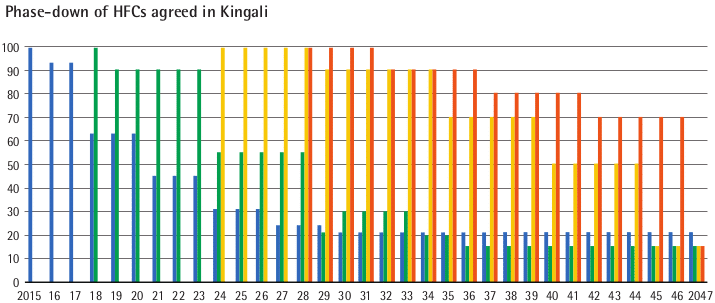
Europe: Phase down under the European F-gas regulations Baseline calculated from average annual consumption from 2009-2012. Freeze in 2015, followed by a first reduction in 2016. |
 |
Non-A5 (developed countries): Baseline calculated from average annual consumption from 2011-2013. |
 |
A5 (developing countries) – Group 1: Baseline calculated from average annual consumption from 2020-2022. Freeze in 2024, followed by a first reduction in 2029. |
 |
A5 (developing countries) – Group 2 (GCC, India, Iran, Iraq, Pakistan) Baseline calculated from average annual consumption from 2024-2026. Freeze in 2028, followed by a first reduction in 2032. |
Why develop this standard?
The purpose is to provide guidelines for safe design, construction, installation, and operation of refrigerating systems for thermal containers using flammable refrigerants, as well as to provide for the safe disposal of flammable refrigerants. Current preferred refrigerants, such as, R-134a and R-404A – both non-flammable hydrofluorocarbons (HFC) – are considered to contribute to global warming. Therefore their use is regulated in many countries, and the refrigerants currently in use will have to be phased out gradually.
HFC Phase Down – Kigali Agreement
In Kigali on October 15, 2016, the world reached an agreement to phase-down hydrofluorocarbons (HFCs). It is regarded as one of the most significant actions governments have ever taken to protect the climate. HFCs are highly potent greenhouse gases that have a global warming potential thousands of times that of carbon dioxide (CO2).
News from ISO TC104 Sub-committee 4 (Identification and communication)
Working Group 2, responsible for maintaining and developing ISO standards for AEI (Automatic Equipment Identification) for containers and container related equipment, met in Atlanta, USA from November 1 to November 2. This group is currently working on a technical specification, TS 18625, Freight containers – Container Tracking and Monitoring System (CTMS). The development of this document is based on dialogue with current and potential users of container tracking and monitoring systems. These dialogues include discussion of solutions that can deliver a minimal capability at low cost which can become broadly deployed in global container operations. This technical specification provides guidance for the requirements for a system, and its enabling devices, used to track, monitor and/or report the status of the container.
Solutions for dangerous or valuable cargoes have already been developed, so the purpose of TS 18625 is focusing on lower-tier systems based on a building block approach that can be expanded as technology and requirements change. The document describes and defines architecture, functions, operation, interfaces, data management, safeguard measures, levels of performance, communications, and more.
The working group intends to present the final document at the March TC104 meetings in March.
News from Sub-Committee 1 (General purpose containers):
Working Group 1 (General Cargo Containers):
ISO 668: Classification, Dimensions and Rating
- Amendment 2: Increase of MGM has been completed.
- Amendment 3: Addition of 1 CCC container is at stage DIS (Draft International Standard) for three months, awaiting technical comments which are expected prior to the next gathering of WG1 to be held during the week of the ISO TC104 plenary in Paris.
ISO1496/1: Specification and Testing
No new development.
To be noted:
- ISO 1496/2 (reefers) is referring now to ISO 1496/1 for testing specifications.
- ISO TR 15070: Rational for structural test criteria. This item will be discussed at the next WG1 meeting.
Alternatives to be considered:
- Leave it as it is
- Delete it
- Incorporate it into ISO 1496/1
Working Group 2 (Handling and Securing)
ISO 1161:2016: Corner and intermediate fittings – Specifications
Following a comprehensive review, as requested by the IMO, this standard was updated and published on July 11, 2016.
ISO 3874: Handling and Securing
Also reviewed as requested by the IMO, modifications will be circulated to TC104 SC1 members for Draft International Standard voting.